


Page 65 - Tehelka-May18
P. 65
theStack                                                   DIRECTION OF HISTORY

                                                                  HASN’T BEEN CERTAIN
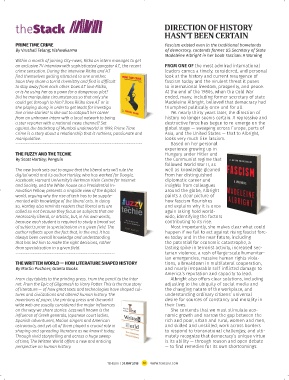
       Prime time crime                                            Fascism existed even in the traditional homelands
       By Vrushali Telang; Vishwakarma                             of democracy, contends former US Secretary of State
                                                                   Madeleine Albright in her book Fascism: A Warning
       Within a month of joining City-news, Ritka an intern manages to get
       an exclusive TV interview with sophisticated gangster A.T., the recent   From one oF the most admired international
       crime sensation. During the interview Ritika and A.T        leaders comes a timely, considered, and personal
       find themselves getting attracted to one another.           look at the history and current resurgence of
       Soon they share a torrid chemistry and find is difficult    fascism today and the virulent threat it poses
       to stay away from each other. Does A.T love Ritika,         to international freedom, prosperity, and peace.
       or is he using her as a pawn for a dangerous plot?          At the end of the 1980s, when the Cold War
       Did he manipulate circumstances so that only she            ended, many, including former secretary of state
       could get through to him? Does Ritika love A.T or is        Madeleine Albright, believed that democracy had
       she playing along in order to get leads for investiga-      triumphed politically once and for all.
       tive crime stories? Is she out to catapult her career         Yet nearly thirty years later, the direction of
       from an unknown intern with a local network to being        history no longer seems certain. A repressive and
       a star reporter with a national news channel? Set           destructive force has begun to re-emerge on the
       against the backdrop of Mumbai underworld in 1999, Prime Time   global stage — sweeping across Europe, parts of
       Crime is a story about a relationship that is ruthless, passionate and   Asia, and the United States — that to Albright,
       manipulative.                                               looks very much like fascism.
       --------------------------------------------------------------------------  Based on her personal
                                                                   experience growing up in
       the fuzzy and the techie                                    Hungary under Hitler and
       By Scott Hartley; Penguin                                   the Communist regime that
                                                                   followed World War II, as
       The new book sets out to argue that the liberal arts will rule the   well as knowledge gleaned
       digital world and its author Hartley, who has worked for Google,   from her distinguished
       Facebook, Harvard University’s Berkman Klein Centre for Internet   diplomatic career and
       and Society, and the White House as a Presidential In-      insights from colleagues
       novation Fellow, presents a ringside view of the digital    around the globe, Albright
       world, arguing why the rise of tech has to be supple-       paints a clear picture of
       mented with knowledge of the liberal arts. In doing         how fascism flourishes
       so, Hartley also reminds readers that liberal arts are      and explains why it is once
       called so not because they focus on subjects that are       again taking hold world-
       necessarily liberal, or artistic, but, in his own words,    wide, identifying the factors
       because each student is required to study a broad set       contributing to its rise.
       of subjects prior to specialisation in a given field. The     Most importantly, she makes clear what could
       author reflects upon the fact that, in the end, it has      happen if we fail to act against rising fascist forc-
       always been overall knowledge and understanding             es today and in the near future, including
       that has led him to make the right decisions, rather        the potential for economic catastrophe, a
       than specialisation in a given field.                       lasting spike in terrorist activity, increased sec-
       ----------------------------------------------------------  tarian violence, a rash of large-scale humanitar-
                                                                   ian emergencies, massive human rights viola-
       the written world — how literature shaPed history           tions, a breakdown in multilateral cooperation,
       By Martin Puchner; Granta Books                             and nearly irreparable self-inflicted damage to
                                                                   America’s reputation and capacity to lead.
       From clay tablets to the printing press. From the pencil to the inter-  Albright also offers clear solutions, including
       net. From the Epic of Gilgamesh to Harry Potter. This is the true story   adjusting to the ubiquity of social media and
       of literature — of how great texts and technologies have shaped cul-  the changing nature of the workplace, and
       tures and civilizations and altered human history. The      understanding ordinary citizens’ universal
       inventions of paper, the printing press and the world       desire for sources of constancy and morality in
       wide web are usually considered the major influences        their lives.
       on the way we share stories. Less well known is the           She contends that we must stimulate eco-
       influence of Greek generals, Japanese court ladies,         nomic growth and narrow the gap between the
       Spanish adventurers, Malian singers and American            rich and poor, urban and rural, women and men,
       astronauts, and yet all of them played a crucial role in    and skilled and unskilled; work across borders
       shaping and spreading literature as we know it today.       to respond to transnational challenges; and ulti-
       Through vivid storytelling and across a huge sweep          mately recognize that democracy’s unique virtue
       of time, The Written World offers a new and enticing        is its ability — through reason and open debate
       perspective on human history.                               — to find remedies for its own shortcomings.


                                            Tehelka / 31 may 2018  65  www.Tehelka.com


     65 Stack&BookReview.indd   3                                                                       17/05/18   4:04 PM

